5 Coffee Office Machine Picks for Busy Workplaces (2026)
If you are choosing a coffee office machine, start with headcount, peak-hour demand, plumbing, and where the finished coffee will be served. We compare five workplace-ready brewers by water setup, batch workflow, heat holding, installation, and the compromise each one asks you to accept.
John CrestaniEspresso Equipment Specialist
Last Updated
The short version
Which coffee office machine should you choose?
Among these five, the BUNN CWTF15-3 is our research-based starting pick for a busy office that has plumbing and needs multiple pots ready during peak demand. Choose the SYBO SF-CB-2GA when plumbing is not practical, the SYBO SF-CB-1AA when a portable thermal carafe suits meetings, the NUPANT RPA-386 when you want auto-fill plus an airpot, or the NUPANT ABR-386 when three warmed decanters are more useful than portability.
Testing transparency: This is a research-based comparison of manufacturer documentation and workplace design tradeoffs, not a hands-on laboratory test. Recommendations apply to the five models listed here. Manufacturer brew-time and heat-retention claims are identified as claims rather than independent measurements.
Office coffee is a traffic problem as much as a brewing problem
We compared the documented specifications of each machine against four workplace buying criteria. The goal is not to reward the longest feature list; it is to identify which workflow is least likely to create queues, stale coffee, constant refilling, or maintenance friction during a normal workday.
Peak-hour throughputCan the brewer keep up when several people want coffee within the same 15–30 minute window?
Water workflowDoes the office need manual refilling, or is a direct water line worth the installation?
Serving & heat holdingWill coffee sit on a warmer, move in a thermal carafe, or dispense from an airpot?
Amazon links in this table are paid links. On a phone, swipe sideways to see every column. Prices and availability change frequently, so this table intentionally does not display them.
Five workplace coffee machines: water setup, serving style, buyer fit, and main tradeoff
Espresso Mastered:The EspressoFinder.com Guide for Enthusiasts and Professionals
Choose smarter. Brew better from day one.
A long feature list does not tell you whether a coffee setup will be easy to live with. This guide helps you separate useful specifications from marketing noise before you spend your money.
Separate useful specifications from marketing noise
Match brewing workflow and capacity to real daily demand
Spot hidden cleaning, water, accessory, and maintenance costs
Use a clear checklist to compare coffee equipment
Free digital guide · Delivered by email · Privacy Policy
Our five office picks, with the tradeoffs explained
A good workplace brewer is the one that matches how people actually take breaks. A plumbed multi-pot system can be perfect for a busy shared floor and completely unnecessary for a ten-person office with staggered schedules.
Best for a busy plumbed office
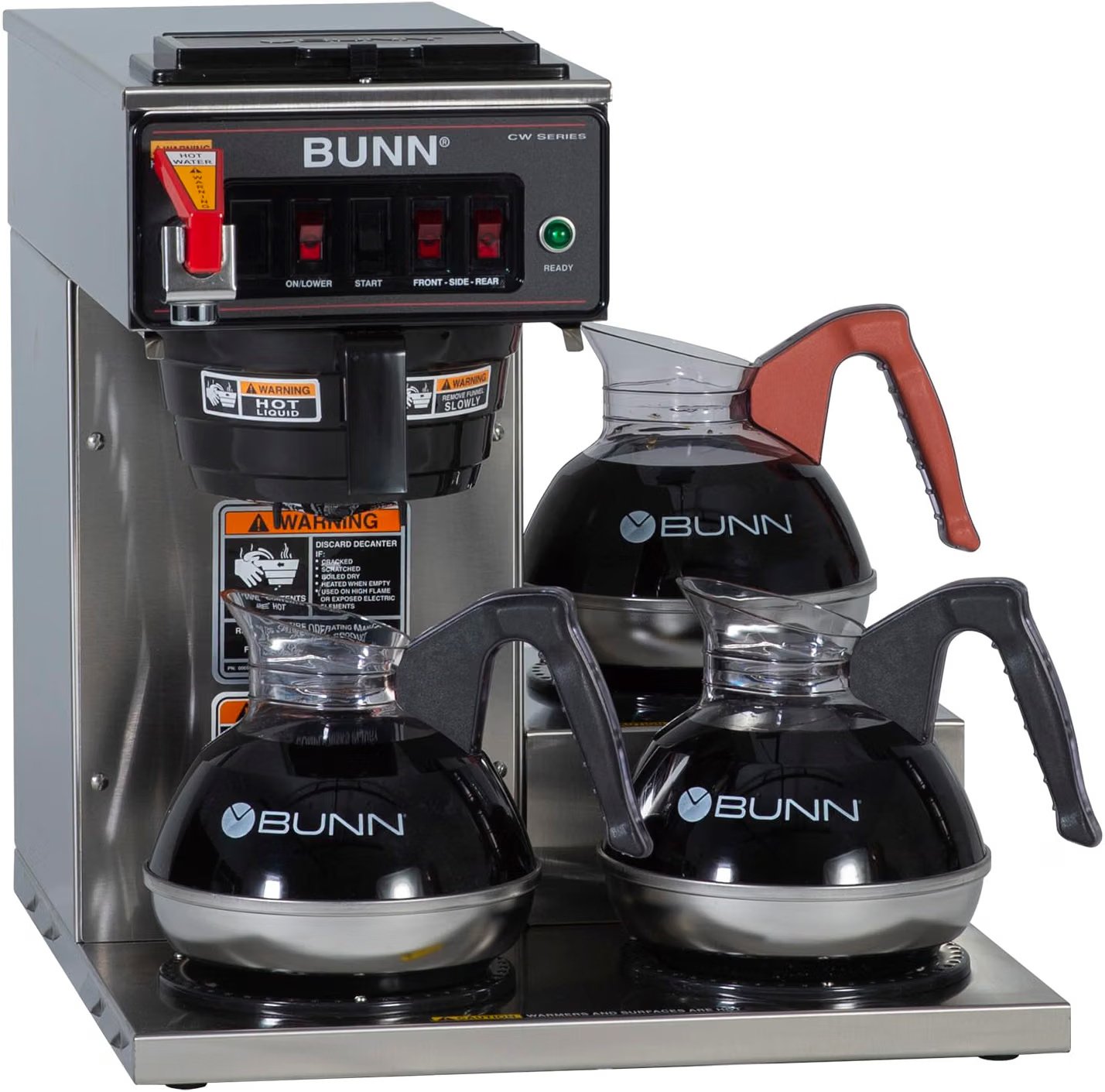
1. BUNN CWTF15-3 12-Cup Automatic Coffee Brewer
The strongest fit here for an office that wants fast repeat brewing, a direct water line, and three warmers ready for staggered break-room demand.
Buy it ifYour break room has a water connection and several teams may need coffee at the same time.
Skip it ifYou cannot plumb the machine or you want coffee held in insulated carafes instead of on warming plates.
The CWTF15-3 is built around throughput rather than home-kitchen convenience. BUNN lists it as a 12-cup automatic brewer with three lower warmers, a hot-water faucet, and a plumbed water connection. That makes the workflow simple once installed: load coffee, start the brew, and rotate decanters as demand rises.
The tradeoff is infrastructure and counter depth. BUNN lists the machine at 17.3 inches high, 16.4 inches wide, and 21.4 inches deep, with a 120-volt, 1670-watt electrical configuration. It is more commitment than a pour-over brewer, but that commitment is exactly what makes sense in a high-traffic office where manual reservoir refills become a daily nuisance.
Brewer12-cup automatic
WaterPlumbed, 20–90 PSI listed
WarmersThree lower warmers
What we like
Direct water line removes manual refilling
Three warmers support overlapping demand
Commercial BUNN documentation and service ecosystem
What to consider
Requires plumbing
Deep commercial footprint
Glass-decanter warming is less portable than thermal service
Specification source reviewed: BUNN Commercial documentation for model 12950.0212 (CWTF15-3). Editorial conclusions are our own.
A straightforward office choice when you need commercial-style batch brewing but cannot add a dedicated water line.
Buy it ifYou want two warming positions, a 12-cup batch size, and a pour-over setup that can move or install easily.
Skip it ifYou want automatic refilling or prefer a thermal carafe that can be carried into meeting rooms.
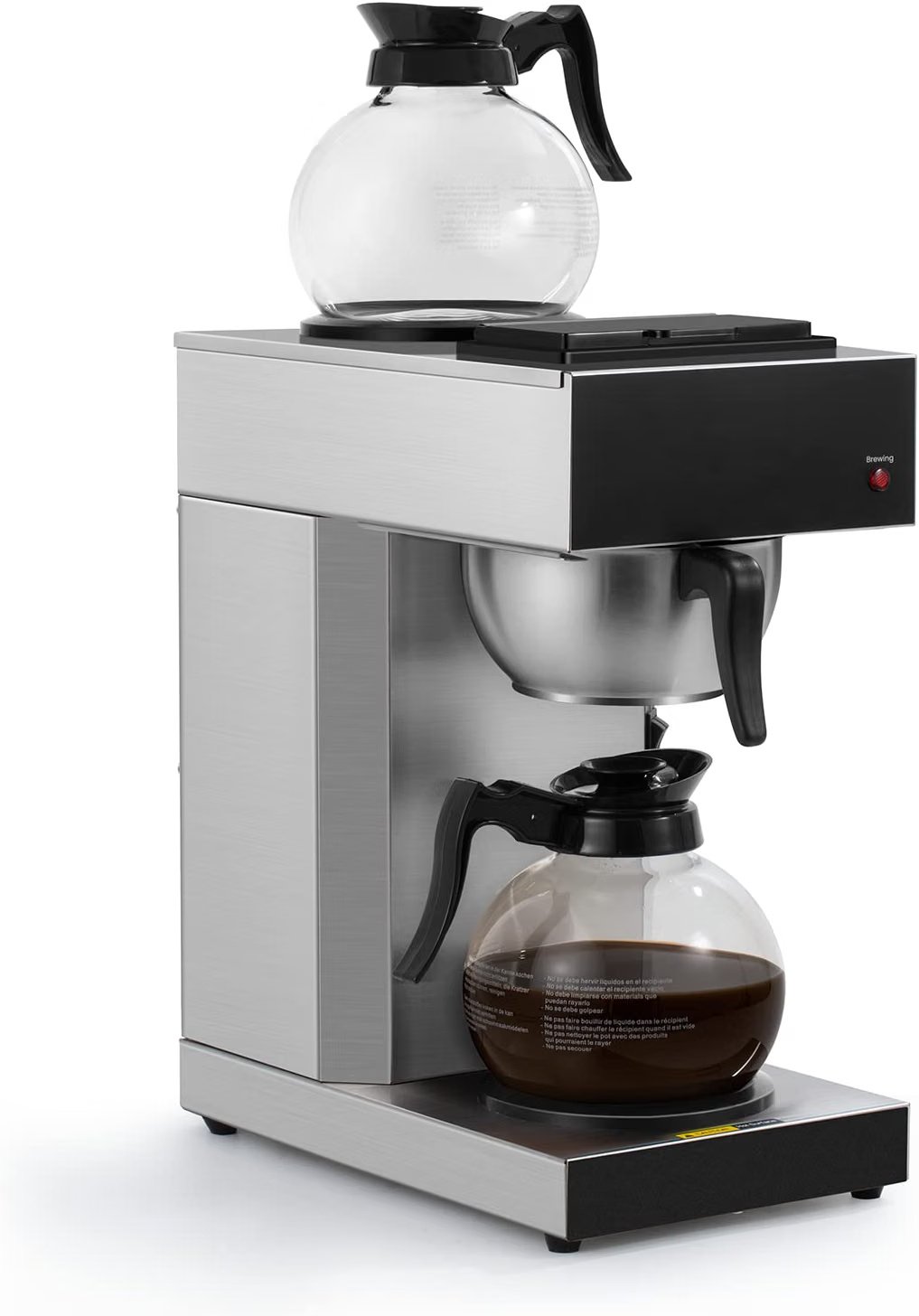
The SF-CB-2GA keeps the setup intentionally simple. Its operating documentation lists a 12-cup capacity and commercial use, while the product design provides a main hot plate plus an extra warming plate. In practice, that means one pot can be serving while another is being brewed or held for the next wave of employees.
Because it is a pour-over brewer, the office still needs someone to add water for each batch. That is not a problem in a smaller break room, but it becomes noticeable when dozens of people arrive within the same short window. For higher-volume or unattended service, a plumbed brewer is the more hands-off choice.
Capacity12 cups listed
WaterManual pour-over
ServingDual warming plates
What we like
No plumbing requirement
Two warming positions for staggered service
Simple commercial controls
What to consider
Manual water refills
Hot plates require attention to holding time
Less convenient for carrying coffee to conference rooms
Specification source reviewed: SYBO operating instructions for model SF-CB-2GA. Editorial conclusions are our own.
3. SYBO SF-CB-1AA 12-Cup Brewer with Thermal Carafe
A better fit for offices that want to brew at the coffee station and carry the finished batch to a conference room without relying on a hot plate.
Buy it ifPortability and heat retention matter more than keeping several glass decanters on warmers.
Skip it ifYour peak demand is so high that one 74-ounce thermal carafe will be emptied immediately.
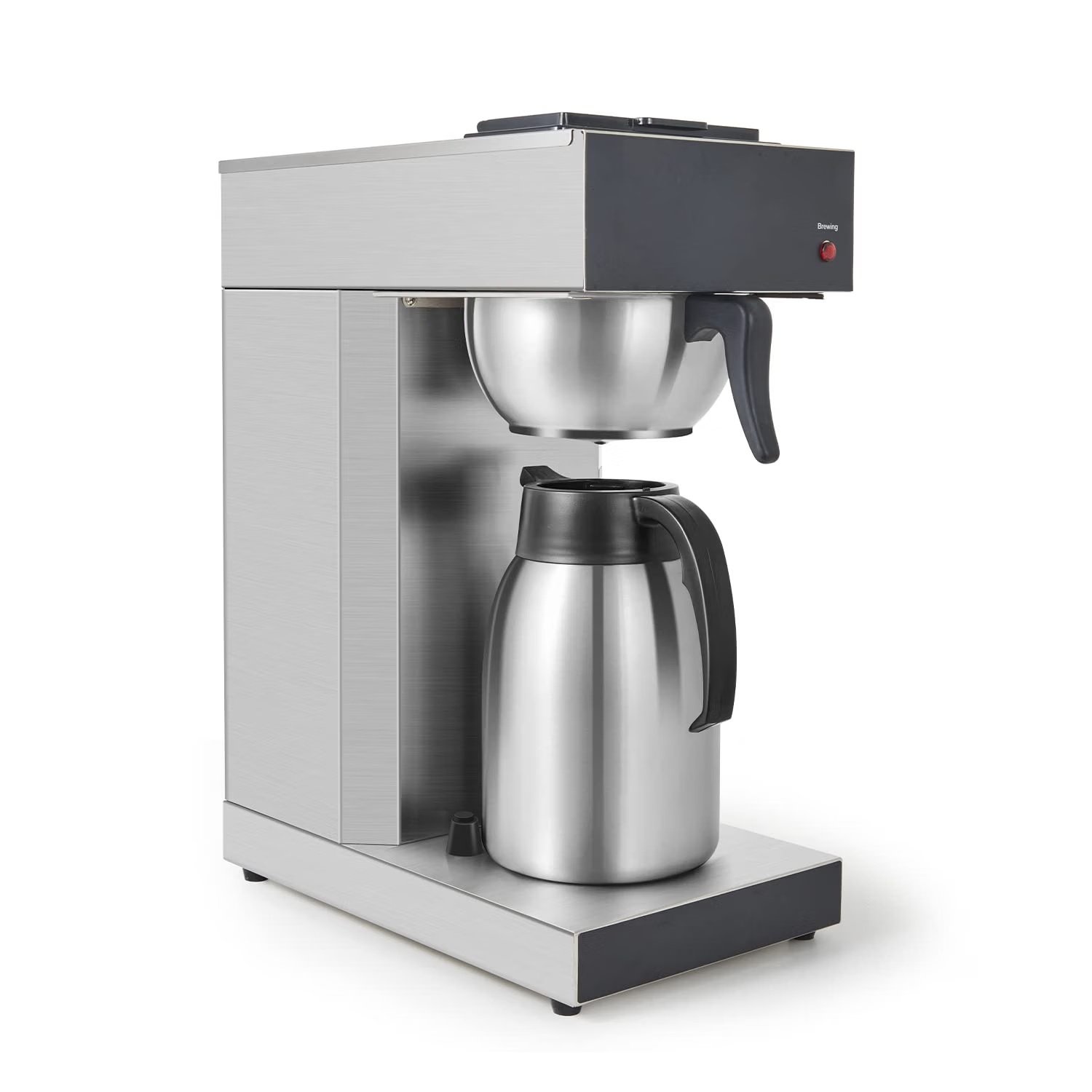
The SF-CB-1AA changes the office workflow by using a thermal carafe instead of making a glass decanter sit on a warmer. Product and manual documentation identify a 12-cup, 74-ounce capacity, 120-volt operation, and a stainless-body commercial design. For meetings, reception areas, and smaller break rooms, the ability to move the carafe is a practical advantage.
Thermal holding also avoids continuously heating the finished coffee from below, but capacity still matters. One carafe can disappear quickly during a morning rush. If your office routinely has several dozen people arriving together, a multi-pot or airpot setup gives you more buffer.
Capacity12 cups / 74 oz
CarafeThermal
Power120 V; 1450 W listed
What we like
Portable thermal serving
No need to keep a glass pot on a hot plate
Narrower single-carafe workflow
What to consider
One-carafe capacity can be limiting
Manual filling remains part of the routine
Tall format needs vertical clearance
Specification source reviewed: SYBO documentation for model SF-CB-1AA. Editorial conclusions are our own.
A useful middle ground for offices that want a direct water line plus an insulated 2.2-liter airpot that can move away from the brewer.
Buy it ifYou want automatic water filling and a portable airpot for a shared break room, meeting area, or reception space.
Skip it ifYou cannot add a water line or you would rather keep multiple glass decanters visible on warming plates.
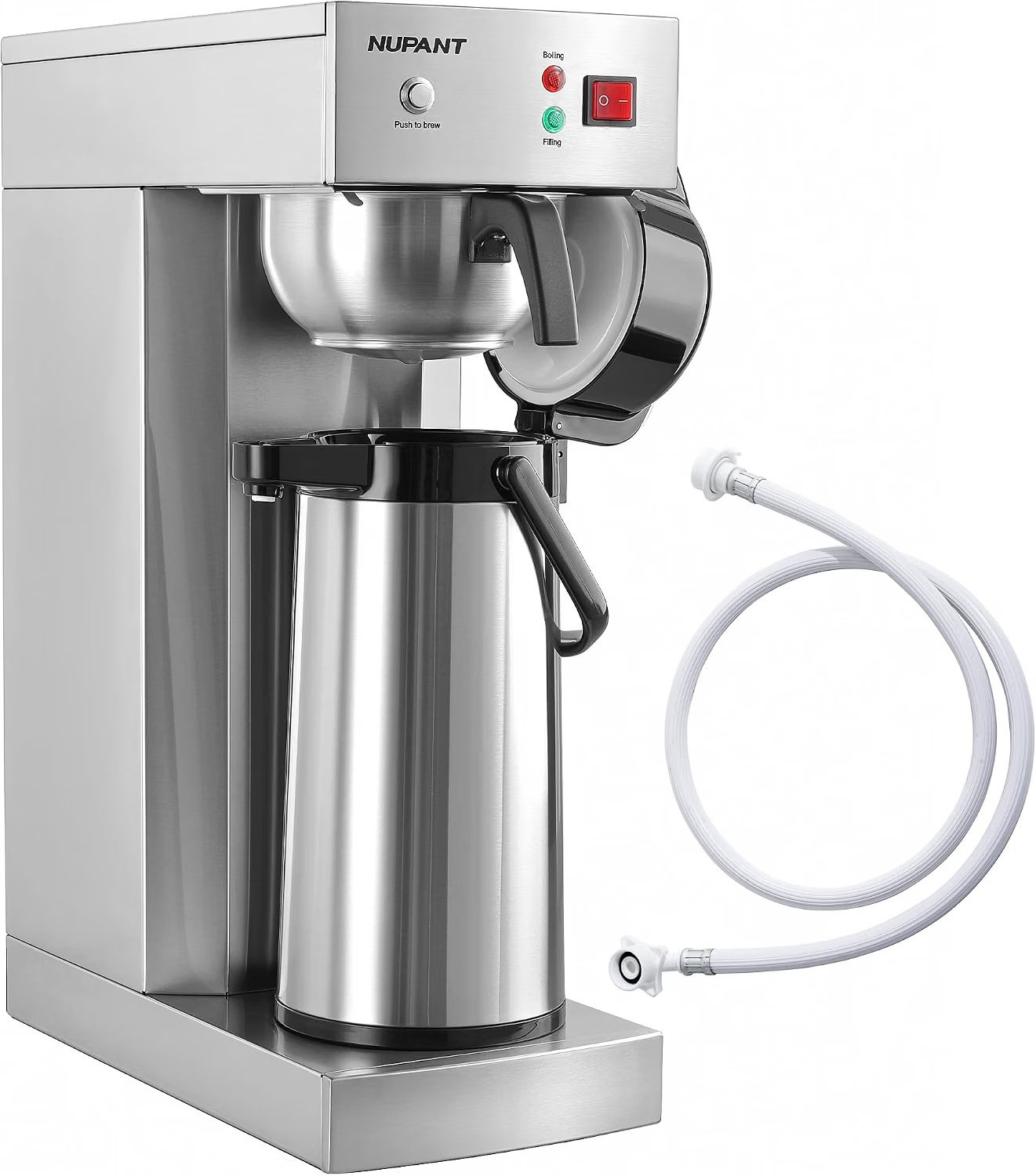
NUPANT positions the RPA-386 as an auto-filling commercial airpot brewer with a direct water line. Manufacturer documentation lists a 2.2-liter (74-ounce) airpot, 120-volt operation, and 1450 watts. That combination is well suited to an office where one person should not have to keep refilling a reservoir throughout the day.
The insulated airpot is the reason to choose this format over a multi-warmer brewer. You can brew at the machine and move the coffee closer to a meeting or serving area. NUPANT also claims a roughly nine-minute full-batch brew cycle; treat that as a manufacturer specification rather than an independently measured result.
Airpot2.2 L / 74 oz
WaterDirect-line auto fill
Power120 V / 1450 W listed
What we like
Automatic water filling
Portable insulated airpot
Good separation between brewing and serving locations
What to consider
Requires plumbing
One airpot may be too little for peak surges
Long-term independent ownership data is limited
Specification source reviewed: NUPANT product documentation for model RPA-386; brew-time claim is manufacturer stated. Editorial conclusions are our own.
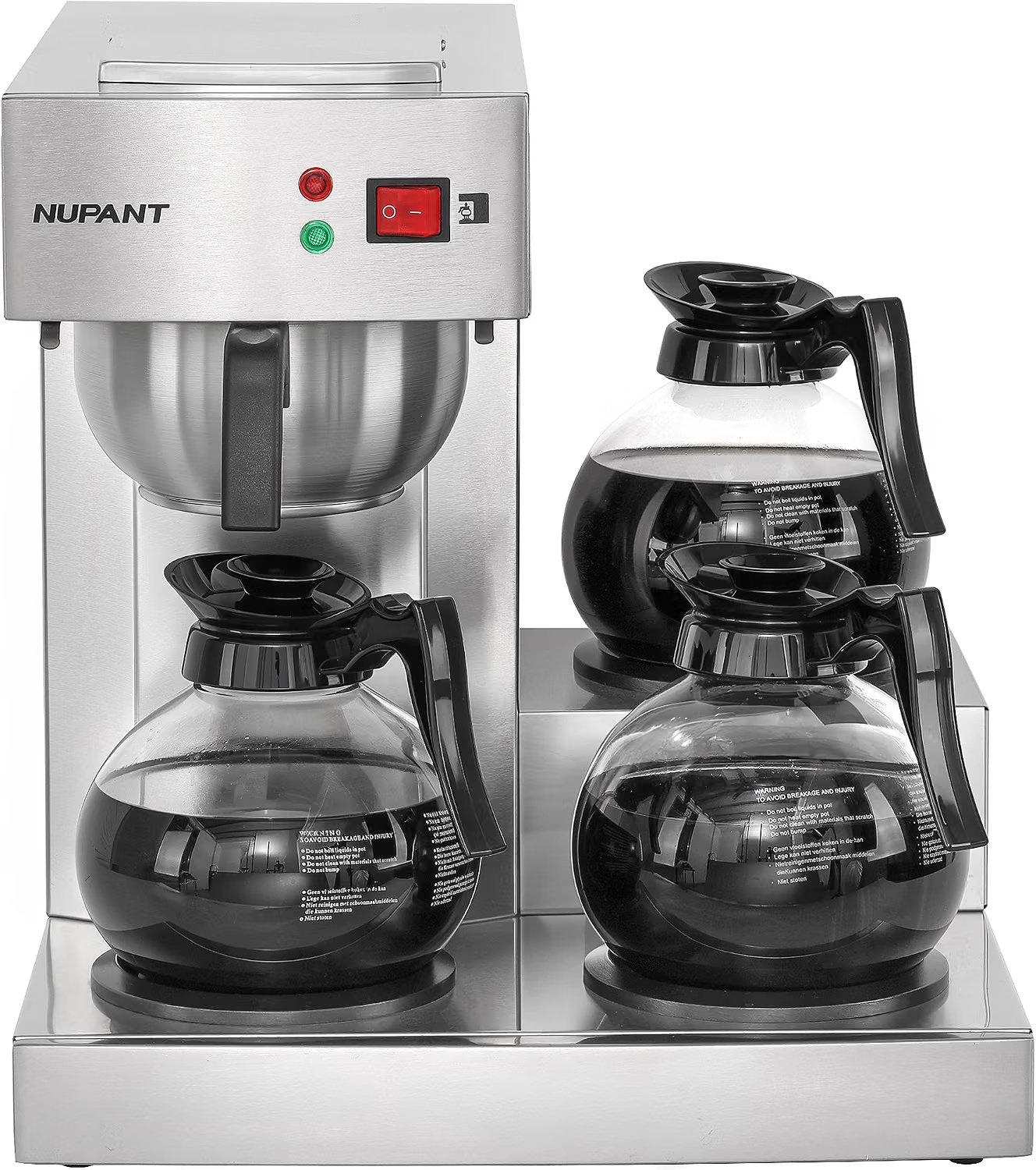
Designed for offices that value ready-to-pour capacity: three warmers and three decanters can keep multiple batches staged during a busy break period.
Buy it ifYou need several pots available at once and prefer a manual-fill system that does not depend on a fixed water connection.
Skip it ifCoffee will sit for long periods; a thermal-carafe system is better for slower, spread-out demand.
The ABR-386 is the most capacity-oriented manual-fill option in this group. NUPANT lists a 12-cup, 1.8-liter brew size, three warming plates, three glass decanters, and a stainless-steel commercial body. The manufacturer states a six-minute brew cycle, so the appeal is obvious when a team needs fresh pots in quick succession.
Three warmers are useful only when the office actually turns over the coffee. If one pot sits for too long, the hot plate keeps applying heat after brewing. For a workplace with unpredictable or low traffic, a thermal carafe can be a better fit even if its headline capacity looks smaller.
Batch12 cups / 1.8 L
WarmersThree
Claimed cycleAbout 6 minutes
What we like
Three pots can be staged at once
No fixed plumbing required
Commercial stainless-steel construction
What to consider
Manual water filling
Hot-plate holding suits fast turnover best
Manufacturer brew-time claim is not independently verified
Specification source reviewed: NUPANT product documentation for model ABR-386; cycle time is manufacturer stated. Editorial conclusions are our own.
Four decisions that matter before you buy an office coffee machine
How many people hit the machine at once?
Do not size only by total headcount. Ten people arriving together can create more pressure than thirty employees with staggered schedules. If you need more comparisons, see our best office coffee maker guide.
Can you add a water line?
Plumbed brewing reduces repetitive refilling, but it adds installation and makes the machine less flexible to relocate. A pour-over commercial brewer is simpler when the break-room layout may change.
Hot plates or thermal service?
Warmers are convenient when coffee turns over quickly. Thermal carafes and airpots make more sense when coffee must travel to meeting rooms or sit between smaller waves of demand. For higher-volume formats, compare our commercial coffee brewer machine guide.
What will cleaning and water quality look like?
Assign a simple cleaning routine and follow the manufacturer’s descaling guidance. Hard water can increase scale buildup, so offices with mineral-heavy water should also review water filtration for coffee.
If your workplace is closer to a cafeteria, showroom, or high-volume service counter than a normal break room, our industrial coffee maker and commercial coffee brewer guides cover heavier-duty directions.
Quick answers
Common questions about a coffee office machine
What size coffee machine is good for a 20-person office?
A 12-cup batch brewer is often a practical starting point when demand is staggered. If most employees arrive or take breaks at the same time, prioritize faster repeat brewing, multiple decanters, or a larger thermal/airpot buffer rather than looking only at the nominal cup count.
Is a commercial coffee machine worth it for an office?
It can be when a household brewer creates queues, constant refilling, or repeated replacement. Commercial-style machines are most useful when the office needs back-to-back batches, simple controls, or a dedicated serving station.
Is a plumbed office coffee machine better than a pour-over model?
Neither is automatically better. A plumbed machine reduces manual refilling and is convenient for steady traffic. A pour-over model is easier to install, move, and use in offices where adding a water connection is impractical.
Is a thermal carafe better than a glass pot on a warmer?
A thermal carafe is easier to move and does not depend on a hot plate for holding. Glass decanters on warmers are useful when coffee turns over quickly and staff want to see how many pots are ready. Match the serving style to your office traffic.
How often should an office coffee machine be cleaned?
Rinse and clean coffee-contact parts according to the manufacturer’s routine after use, and follow the machine’s own descaling guidance for mineral buildup. Water hardness can change how often descaling is necessary.
Should an office coffee machine use filtered water?
Filtered water can help when local water has strong tastes, odors, sediment, or high mineral content, but the correct filtration setup depends on the brewer and water chemistry. Follow the equipment manufacturer’s water-quality requirements before adding a treatment system.
Recommended next
Continue your research
These workplace and commercial-coffee guides are closely related to choosing the right coffee office machine.