5 Best Commercial Coffee Brewers for Busy Workplaces (2026)Skip to the article
5 Best Commercial Coffee Brewers for Busy Workplaces (2026)
A commercial coffee brewer should fit the way coffee is actually served: how often staff brew, whether a water line is available, where the finished coffee waits, and how quickly another batch must be ready. We compare five practical options for offices, restaurants, meeting spaces, and service counters.
John CrestaniEspresso Equipment Specialist
Last Updated
The short version
Which commercial coffee brewer should you buy?
Among these five, the BUNN CWTF15-3 is our research-based starting pick for a plumbed workplace or food-service station that needs repeated batches and three warmers. Choose the SYBO SF-CB-2GA when you need a no-plumbing pour-over setup. The SYBO thermal-carafe model makes more sense when coffee must travel to meeting rooms, while VEVOR and crosson are value-oriented multi-pot alternatives that require closer model matching.
Testing transparency: This is a research-based comparison of manufacturer documentation, operating manuals, current product descriptions, and workflow tradeoffs—not a hands-on laboratory test. Amazon listings can change or bundle different accessories, so confirm the exact model, voltage, warmer count, server type, package contents, price, and availability before ordering.
How we evaluated
Commercial brewing is a workflow decision, not just a cup count
We compared the available specifications against four practical buying criteria: batch throughput, installation requirements, coffee holding method, and ownership friction. A 12-cup label tells you the batch size; it does not tell you whether staff will spend the day refilling water, whether coffee will sit too long on a hot plate, or whether the machine fits your electrical and plumbing setup.
ThroughputHow easily can staff brew the next batch when demand spikes?
InstallationDoes the brewer need a direct water line, special clearance, or a higher electrical load?
Holding methodAre you serving from glass decanters on warmers or an insulated thermal server?
Ownership frictionConsider cleaning, filtration, replacement servers, training, and model-specific parts.
For a broader category overview, our commercial coffee brewer machine guide explains the main equipment formats before you narrow down a specific model.
Commercial coffee brewers compared
Amazon links in this table are paid links. On a phone, swipe sideways to see every column. Prices and availability change frequently, so this table intentionally does not display them.
Five commercial coffee brewers: buyer fit, water supply, holding method, and main tradeoff
Espresso Mastered:The EspressoFinder.com Guide for Enthusiasts and Professionals
Choose smarter. Build a better coffee setup.
Commercial coffee equipment can look similar until you compare throughput, water connection, holding method, cleaning, and service needs. This practical guide helps you judge the workflow before you spend your money.
Separate useful specifications from marketing noise
Match capacity, holding method, and installation needs to your routine
Spot hidden accessory, cleaning, and upgrade costs
Use a clear checklist to compare coffee equipment
Free digital guide · Delivered by email · Privacy Policy
Our five picks, with the tradeoffs explained
There is no universal “best” commercial brewer. The right machine is the one whose water supply, batch rhythm, holding method, and maintenance routine match your actual service pattern.
Best overall for plumbed service
1. BUNN CWTF15-3 (12950.0212)
The strongest starting point for offices, diners, churches, and service counters that have a water line and need repeatable 12-cup batches with three independently controlled holding positions.
Buy it ifYou have a suitable water connection and expect repeated batches through the morning or service period.
Skip it ifYou cannot plumb the brewer, need a compact single-pot setup, or want thermal holding instead of hot plates.
BUNN positions the CWTF15-3 as a medium-volume automatic brewer with a direct water connection, a pour-over backup, a hot-water faucet, and three lower warmers. That combination is practical when staff should be able to start the next batch quickly without measuring reservoir water every cycle.
The installation requirements are the real buying decision. BUNN lists a 120-volt, 1670-watt configuration and a 20–90 PSI water-pressure range, and the machine is substantially deeper than a typical home brewer. If your building has hard or inconsistent water, plan the plumbing together with an appropriate coffee water filtration setup rather than treating filtration as an afterthought.
Water accessPlumbed + pour-over backup
WarmersThree lower
Electrical120 V · 1670 W listed
What we like
Automatic filling reduces repetitive setup
Three warmers support staggered service
Hot-water faucet adds utility at a beverage station
Specification source reviewed: BUNN Commercial documentation for product 12950.0212. Capacity and installation details are manufacturer-listed specifications.
View on Amazon ↗Paid link · confirm model, price, package contents, and availability
Best pour-over option
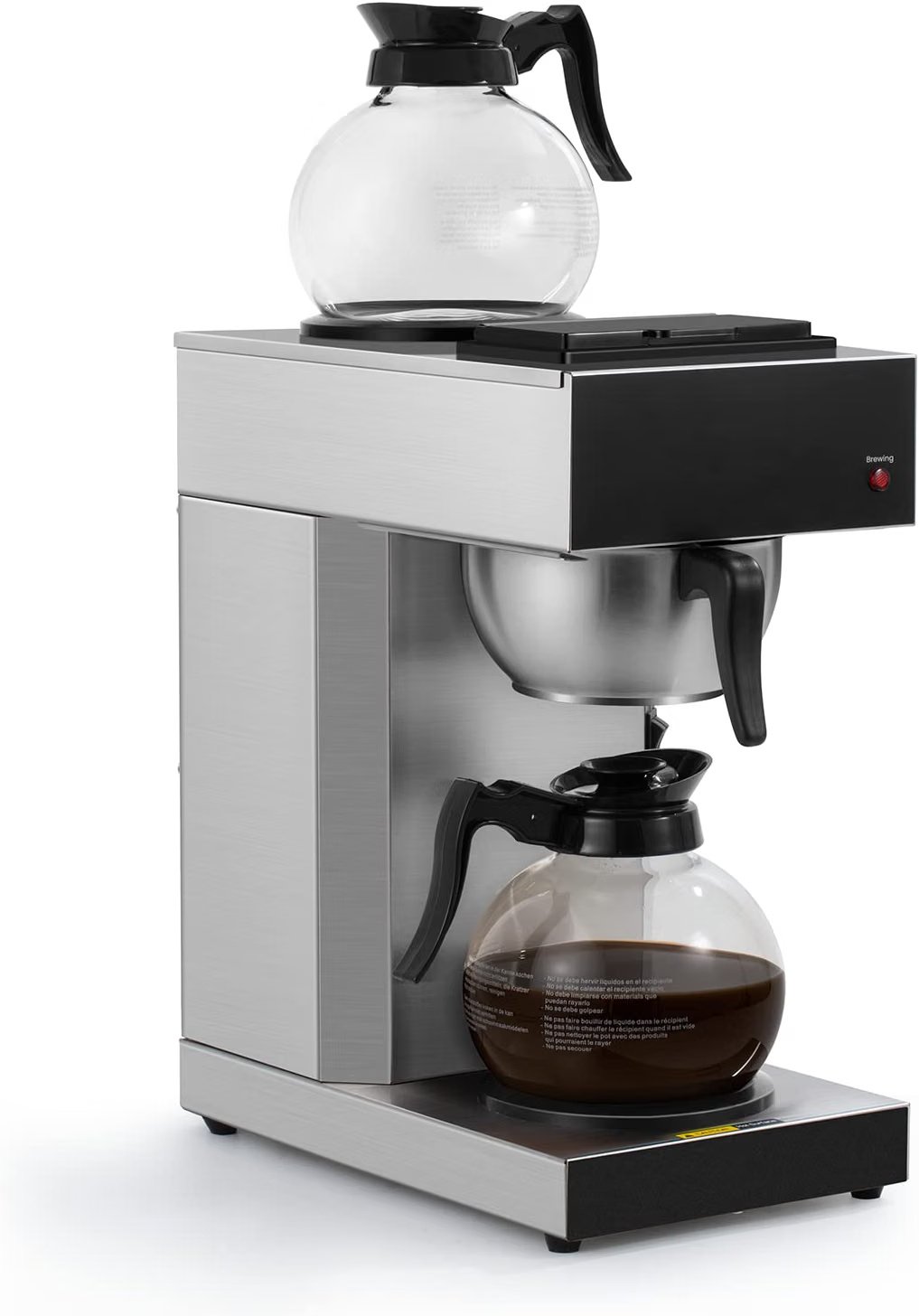
2. SYBO SF-CB-2GA
A straightforward choice when you want commercial-style drip brewing and two-pot holding without installing a dedicated water line.
Buy it ifYou need a movable commercial brewer for an office, event room, small café, or counter without a plumbed connection.
Skip it ifStaff will be brewing continuously enough that manually adding water becomes a bottleneck.
The SF-CB-2GA is built around a simple pour-over routine: fill the reservoir, load the filter basket, brew a 12-cup batch, and use the main and extra hot plates to manage service. SYBO’s operating documentation identifies the model as a commercial appliance and lists 120-volt operation.
Its advantage is installation flexibility rather than automation. You can place it where a standard outlet and safe counter are available, which makes it a reasonable fit for smaller workplaces. If your priority is specifically employee self-service, compare this workflow with the options in our best office coffee maker guide before deciding.
Brewer typePour-over drip
CapacityApprox. 12 cups
HoldingMain + extra hot plate
What we like
No permanent water line required
Simple controls are easy to train on
Two warming positions support overlapping batches
What to consider
Manual refilling adds labor during busy periods
Glass-decanter holding can overcook coffee if left too long
Documentation shows model-family variations, so match the exact listing
Specification source reviewed: SYBO SF-CB-2GA operating documentation. Exact included accessories and revision should be confirmed on the Amazon listing.
View on Amazon ↗Paid link · confirm model, price, package contents, and availability
Best multi-warmer value
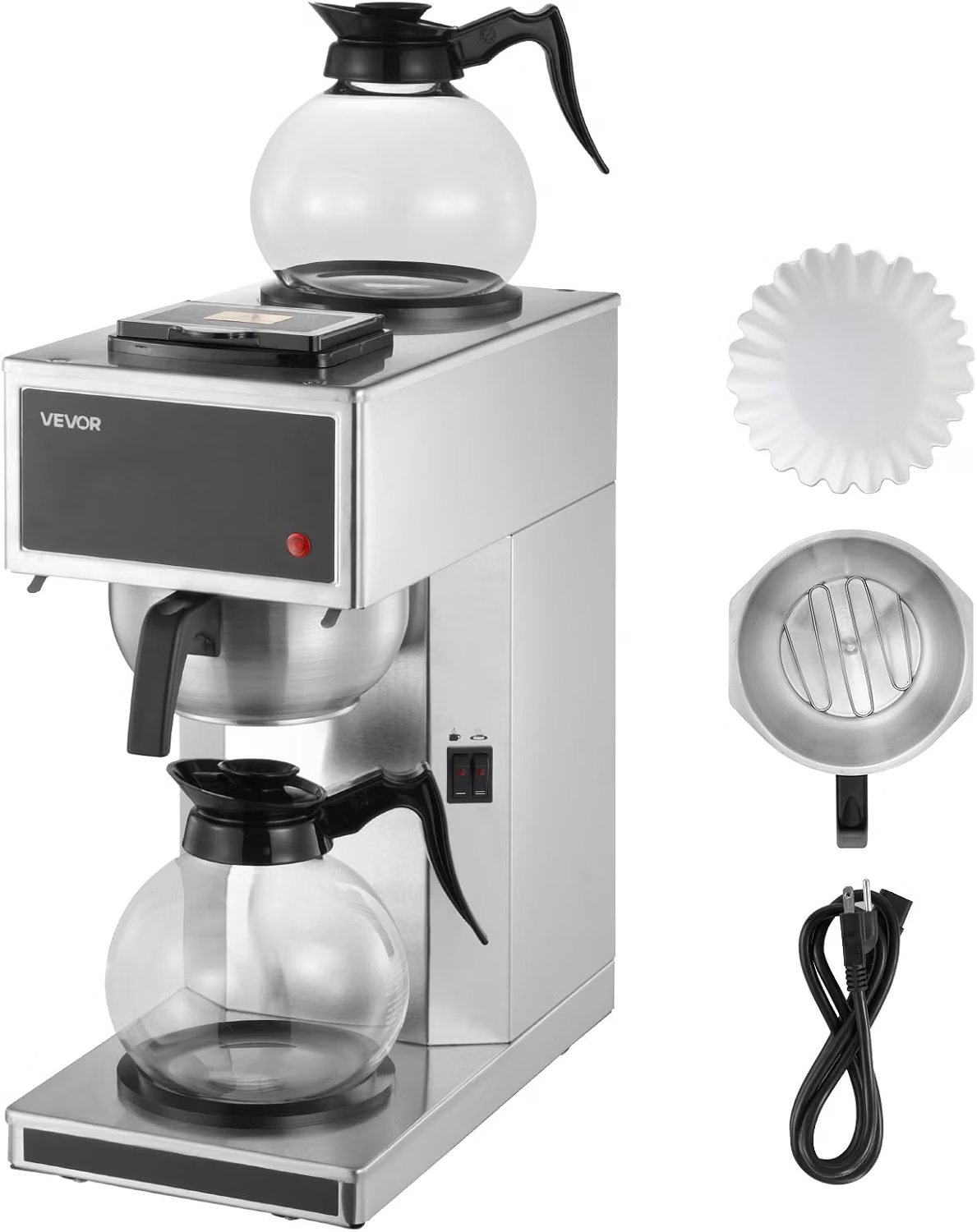
3. VEVOR Commercial Drip Coffee Maker
Worth considering when the goal is to keep several decanters ready at once and you are willing to verify the exact warmer configuration before ordering.
Buy it ifYour service pattern needs multiple pots staged for meetings, breakfast service, or a busy self-serve station.
Skip it ifYou want a narrowly documented model with one standardized configuration and a long commercial service history.
VEVOR sells several 12-cup commercial drip configurations with stainless-steel housings and multiple warmer layouts. Its current commercial-brewer family includes versions with two, three, or four warming positions, which can be useful when demand arrives in waves rather than at a perfectly steady rate.
That variety is also the main shopping risk. A product image with four carafes is not interchangeable with a two-warmer model, so confirm the number of brew heads, warmers, carafes, electrical rating, and model number on the Amazon destination page. If your volume is well beyond batch-brewer territory, compare larger-capacity options in our industrial coffee maker guide instead of simply adding more hot plates.
Batch size12-cup class
ConstructionStainless-steel body listed
ConfigurationMulti-warmer variants
What we like
Multiple holding positions can handle rush periods
Simple drip workflow is familiar to staff
Commercial-focused stainless-steel design
What to consider
Several similar variants make model matching essential
Warm plates are better for short holding than long meetings
Long-term service support is less established than BUNN
Specification source reviewed: VEVOR’s current 12-cup commercial drip brewer family. Confirm the exact variant, warmer count, and included carafes on Amazon.
View on Amazon ↗Paid link · confirm model, price, package contents, and availability
Best for thermal holding
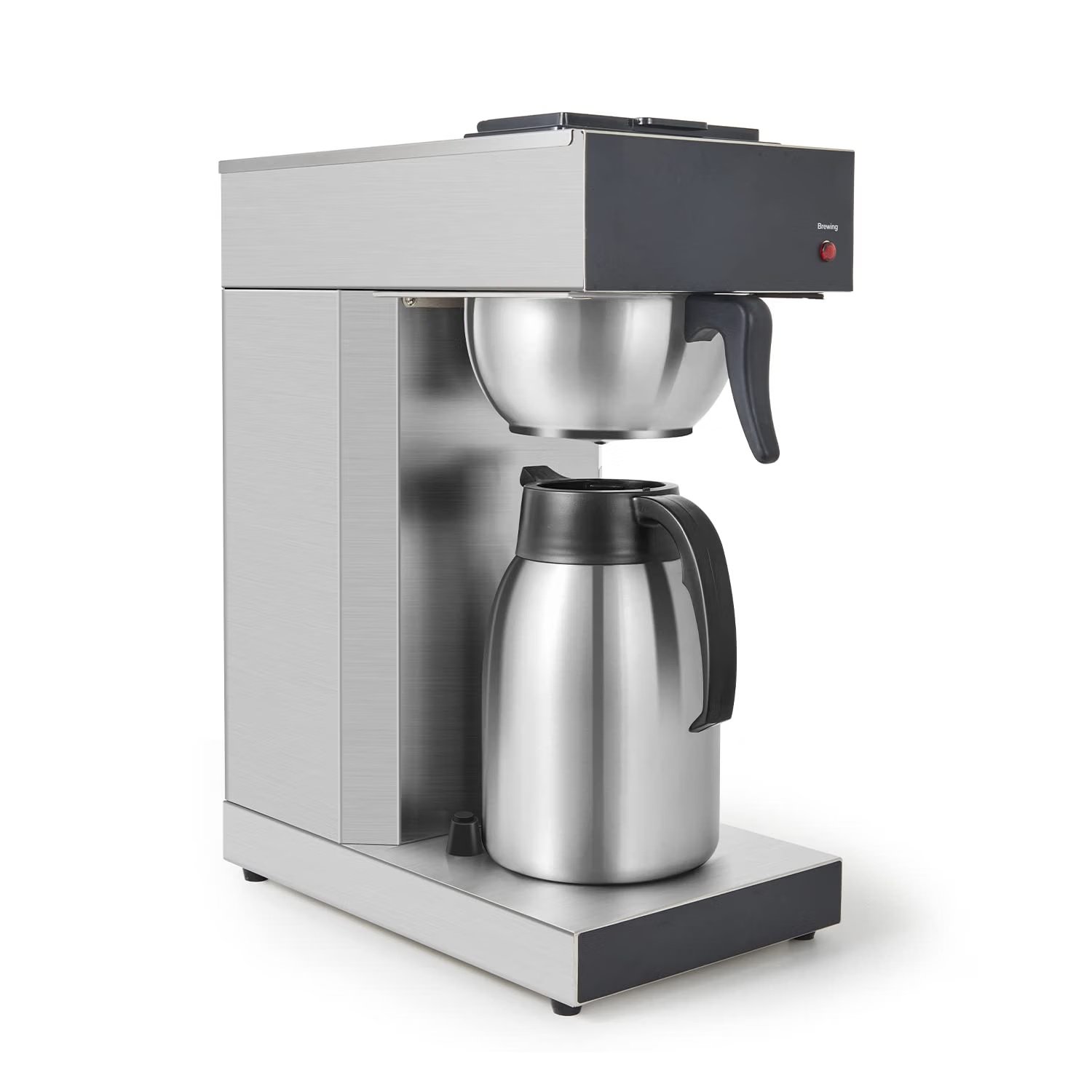
4. SYBO 12-Cup Brewer with 74 oz Thermal Carafe
The most useful format here when brewed coffee needs to leave the machine and travel to a conference room, buffet, reception desk, or another service point.
Buy it ifYou value portability and want to hold coffee in an insulated server rather than cooking it on a warmer plate.
Skip it ifYou need several decanters visible on warmers at the same station or continuous automatic water filling.
A thermal-carafe brewer solves a different problem from a multi-warmer machine. Instead of keeping coffee on direct heat, the brewed batch goes into an insulated 74-ounce server that can be carried to another room or placed on a service table. That makes this format especially useful for offices, catered meetings, and front-desk service.
SYBO’s documentation covers the SF-CB-1AA family within its commercial brewer range, while the product supplied in your affiliate sheet is identified by its 12-cup capacity and 74-ounce thermal carafe. For a broader look at workplace setups, see our guide to coffee machines for offices.
Capacity12-cup class
Server74 oz thermal carafe
WorkflowPour-over / portable serving
What we like
Thermal server can move away from the brewer
No hot plate under the served coffee
Useful for meetings and distributed service points
What to consider
One server can become a bottleneck at higher volume
Thermal performance depends on preheating and lid handling
Confirm the exact model and included carafe on the Amazon page
Specification source reviewed: SYBO commercial brewer documentation plus the exact product description supplied in your affiliate sheet.
View on Amazon ↗Paid link · confirm model, price, package contents, and availability
Best simple two-pot station
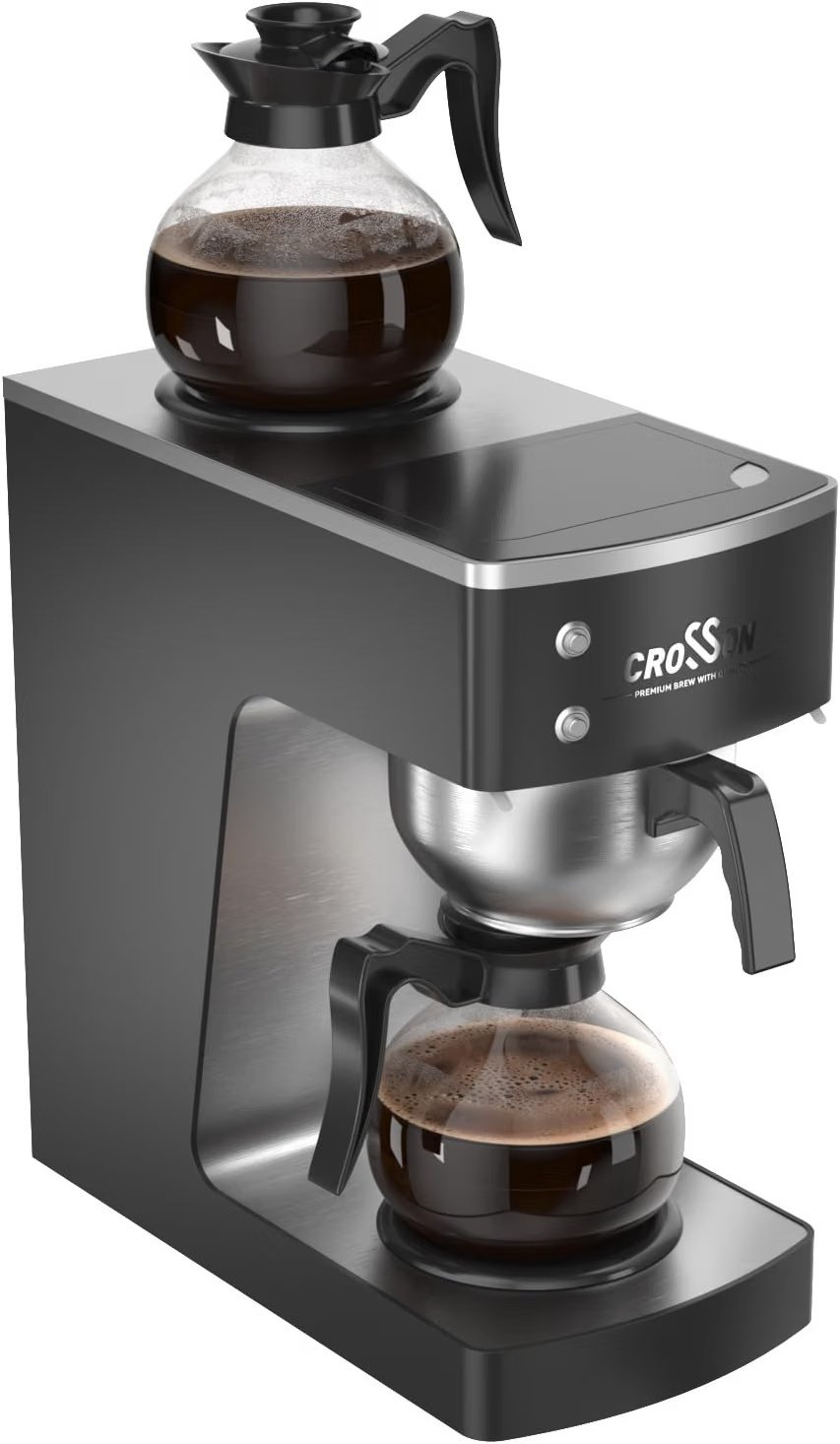
5. crosson 12-Cup Commercial Drip Brewer
A compact two-decanter layout for buyers who want one pot brewing or serving below while a second pot stays ready on the upper warmer.
Buy it ifYou need a conventional pour-over station with two glass decanters and do not need automatic water filling.
Skip it ifYou need heavy all-day throughput, plumbed automation, or broad manufacturer service documentation.
The crosson layout follows a familiar commercial pattern: one lower brewing/holding position plus an upper warmer for a second decanter. Current seller documentation lists a 12-cup brew size, two glass decanters, a 304 stainless-steel funnel, and a 120-volt electrical setup.
This format can work for a small restaurant breakfast station or light counter service, but the available documentation is less extensive than BUNN’s. Treat the Amazon page as the final model check before ordering. For food-service-specific alternatives, compare our restaurant coffee maker guide.
Batch size12 cups listed
WarmersUpper + lower
Electrical120 V · 1610 W seller-listed
What we like
Two-pot workflow without a wide base
304 stainless-steel funnel is listed
Simple controls reduce training time
What to consider
Manual fill is less efficient during continuous service
Independent manufacturer documentation is limited
Glass-decanter coffee should not be held on heat for long periods
Specification source reviewed: current crosson seller documentation. Treat model, dimensions, and included accessories as listing-specific and confirm them on Amazon.
View on Amazon ↗Paid link · confirm model, price, package contents, and availability
Buying guide
Four decisions that matter before you buy a commercial coffee brewer
Plumbed or pour-over?
A plumbed brewer removes repeated reservoir filling and is better for frequent batches. A pour-over machine is easier to place, move, and install. If your needs are heavier, compare the broader industrial coffee maker category before buying multiple small brewers.
Warmers or thermal servers?
Glass decanters on warmers are visible and convenient for short service windows. Thermal servers are better when coffee must stay portable or sit away from the brewer without direct heat.
How many batches per hour?
Estimate peak demand, not average daily consumption. A 12-cup brewer can be ideal for an office yet frustrating at a breakfast rush if staff are constantly waiting for the next cycle.
What does installation require?
Measure width, depth, height, outlet access, amperage, and clearance for pouring water or removing servers. For automatic brewers, include the water line, shutoff access, and water filtration in the plan.
Quick answers
Common questions about commercial coffee brewers
What is a commercial coffee brewer?
A commercial coffee brewer is a batch-brewing machine designed for repeated service in offices, restaurants, cafés, hotels, churches, meeting spaces, and similar environments. Compared with a typical home drip machine, commercial models usually prioritize faster recovery, durable service components, multiple holding options, or direct water connections.
Is a plumbed commercial brewer better than a pour-over model?
Not automatically. A plumbed brewer is more efficient when staff make many batches because it refills from the water line. A pour-over brewer is easier to install and relocate. Choose based on how often you brew and whether a suitable water connection is available.
How many cups per hour should a commercial coffee brewer handle?
Start with your busiest 30–60 minutes. Count expected servings, then add headroom so the brewer can recover from a rush. For light office use, one 12-cup brewer may be enough; restaurants and high-traffic counters may need faster automatic equipment or multiple servers.
Are thermal carafes better than glass decanters on warmers?
Thermal carafes are usually better for portability and longer holding without direct heat. Glass decanters make the coffee level easy to see and work well for quick turnover, but leaving brewed coffee on a hot plate for too long can reduce flavor quality.
What commercial coffee brewer is best for an office?
For a small office without plumbing, a simple pour-over commercial brewer can be easier to install. For a larger workplace with frequent demand, a plumbed automatic brewer reduces staff effort. You can compare more workplace-specific options in our office coffee machine guide.
Recommended next
Continue your research
Compare adjacent commercial brewing formats, higher-capacity equipment, and restaurant-focused setups before you commit to a machine.