5 Best Industrial Coffee Makers for High-Volume Service (2026)Skip to the article
5 Best Industrial Coffee Makers for High-Volume Service (2026)
For most buyers, “industrial” means commercial-duty brewing, faster refill cycles, larger serving capacity, and equipment that fits a real service workflow. We compare five options for restaurants, offices, catering, churches, and other high-volume settings—without pretending that one machine fits every kind of operation.
John CrestaniEspresso Equipment Specialist
Last Updated
The short version
Which industrial coffee maker should you buy?
For a permanent, busy service counter, the BUNN CWTF15-3 is the clearest starting point because it combines automatic water filling, three warmers, and established commercial documentation. Choose the NUPANT airpot brewer when thermal holding and portability matter more than hot plates; VEVOR or SYBO for simpler manually filled commercial stations; and a 100-cup urn when your real problem is serving a large crowd in one batch.
Testing transparency: This is a research-based comparison of manufacturer documentation, operating manuals, supplied product listings, and workflow tradeoffs—not a hands-on laboratory test. “Industrial coffee maker” is a broad shopping term, so we separate plumbed brewers, manual commercial brewers, airpot systems, and large urns rather than treating them as interchangeable.
Commercial capacity is only useful when the workflow keeps up
We compared the listed specifications and operating design of each machine against four buying criteria that matter in real service: throughput, water-feed workflow, how coffee is held after brewing, and ownership friction. Capacity claims are not the same as independently measured cups per hour, so we avoid inventing performance scores where the available documentation does not support them.
Throughput & batch rhythmHow easily can staff start the next batch when demand spikes?
Water-feed workflowIs the brewer plumbed, auto-filling, reservoir-based, or manually filled?
Holding methodWarmers, thermal airpots, and large urns preserve coffee in very different ways.
Amazon links in this table are paid links. On a phone, swipe sideways to see every column. Prices and availability change frequently, so this table intentionally does not display them.
Five commercial-duty coffee makers: best use, water feed, holding method, and main tradeoff
Espresso Mastered:The EspressoFinder.com Guide for Enthusiasts and Professionals
Choose smarter. Brew better from day one.
Commercial coffee equipment can look similar on a product page while requiring very different plumbing, holding, cleaning, and staffing workflows. This practical guide helps you compare what matters before you spend your money.
Separate useful specifications from marketing noise
Match batch size, holding method, water feed, and service workflow to your site
Spot hidden plumbing, filter, cleaning, and replacement-carafe costs
Use a clear checklist to compare commercial coffee equipment
Free digital guide · Delivered by email · Privacy Policy
Our five picks, with the tradeoffs explained
An industrial coffee maker is not automatically the machine with the biggest tank. The better choice is the one whose refill, holding, installation, and cleaning workflow matches the place where it will actually be used.
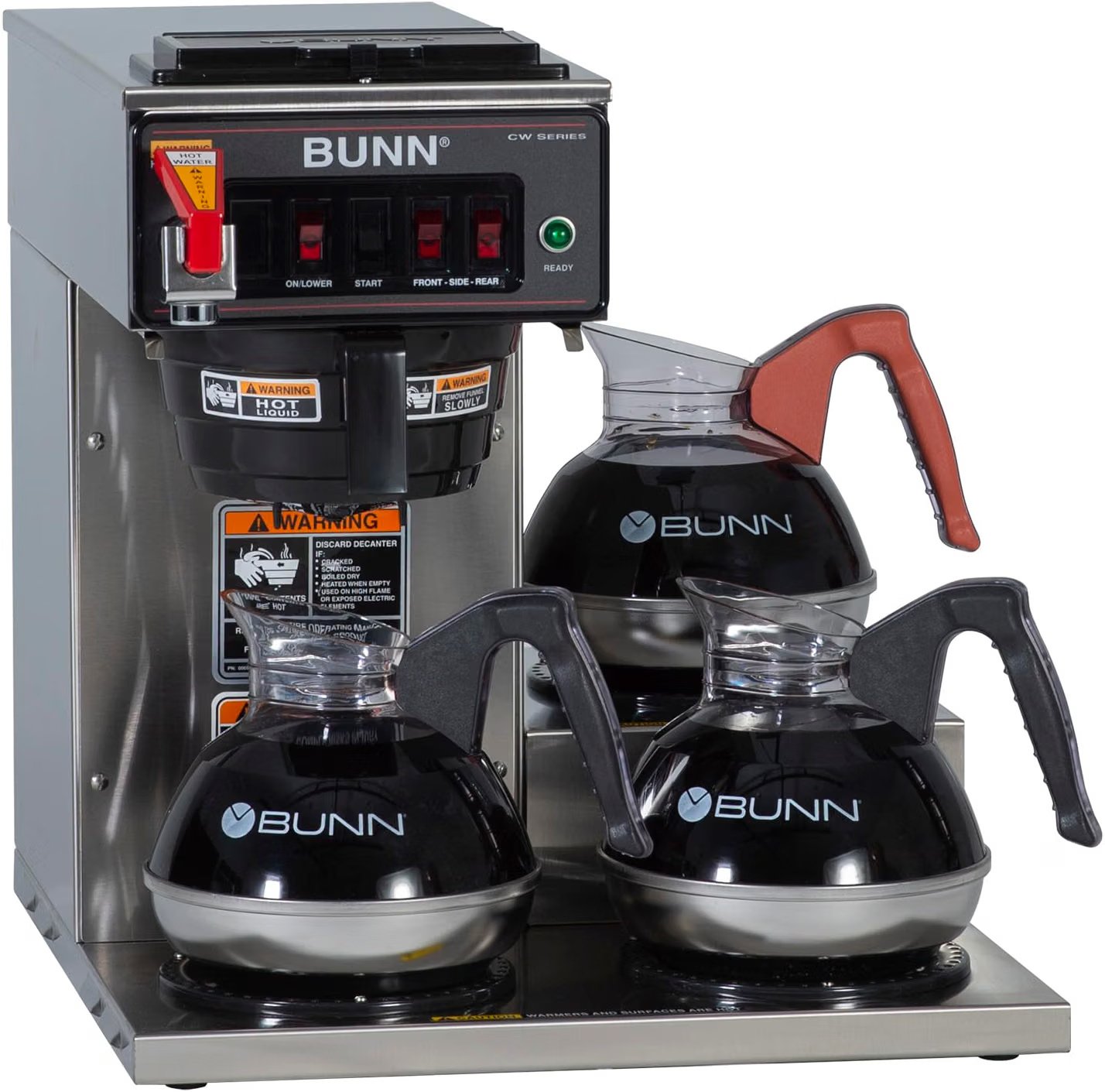
The strongest fit here for restaurants, offices, and service counters that want a plumbed brewer with three lower warmers and a familiar decanter workflow.
Buy it ifYou have a water line and need repeatable 12-cup batches throughout the day.
Skip it ifYou want portable thermal holding or cannot dedicate plumbing and counter width to the brewer.
The CWTF15-3 is closer to what many buyers actually mean by an industrial coffee maker: a commercial-duty brewer designed around repeated batches, a direct water connection, and multiple warmers rather than home-style convenience features. BUNN lists model 12950.0212 as a 12-cup automatic brewer with three lower warmers, a hot-water faucet, stainless construction, and a pourover feature.
Its main advantage is workflow. Once it is plumbed correctly, staff are not carrying pitchers back and forth for every batch, and three lower warmers let a service counter hold multiple decanters. The tradeoff is installation: BUNN specifies a plumbed connection and a 20–90 PSI water-pressure range, so this is a better fit for a permanent location than a temporary coffee station. If you are building a dedicated beverage area, our commercial coffee brewer guide and coffee-water filtration guide are useful next reads.
Brewer12-cup automatic
Holding3 lower warmers
Power / water120V, 1670W · plumbed
What we like
Automatic water-fed workflow
Three lower warmers support busy service
BUNN publishes detailed commercial documentation
What to consider
Requires a suitable water connection
Wide footprint compared with single-warmer brewers
Glass-decanter holding can cook coffee if left too long
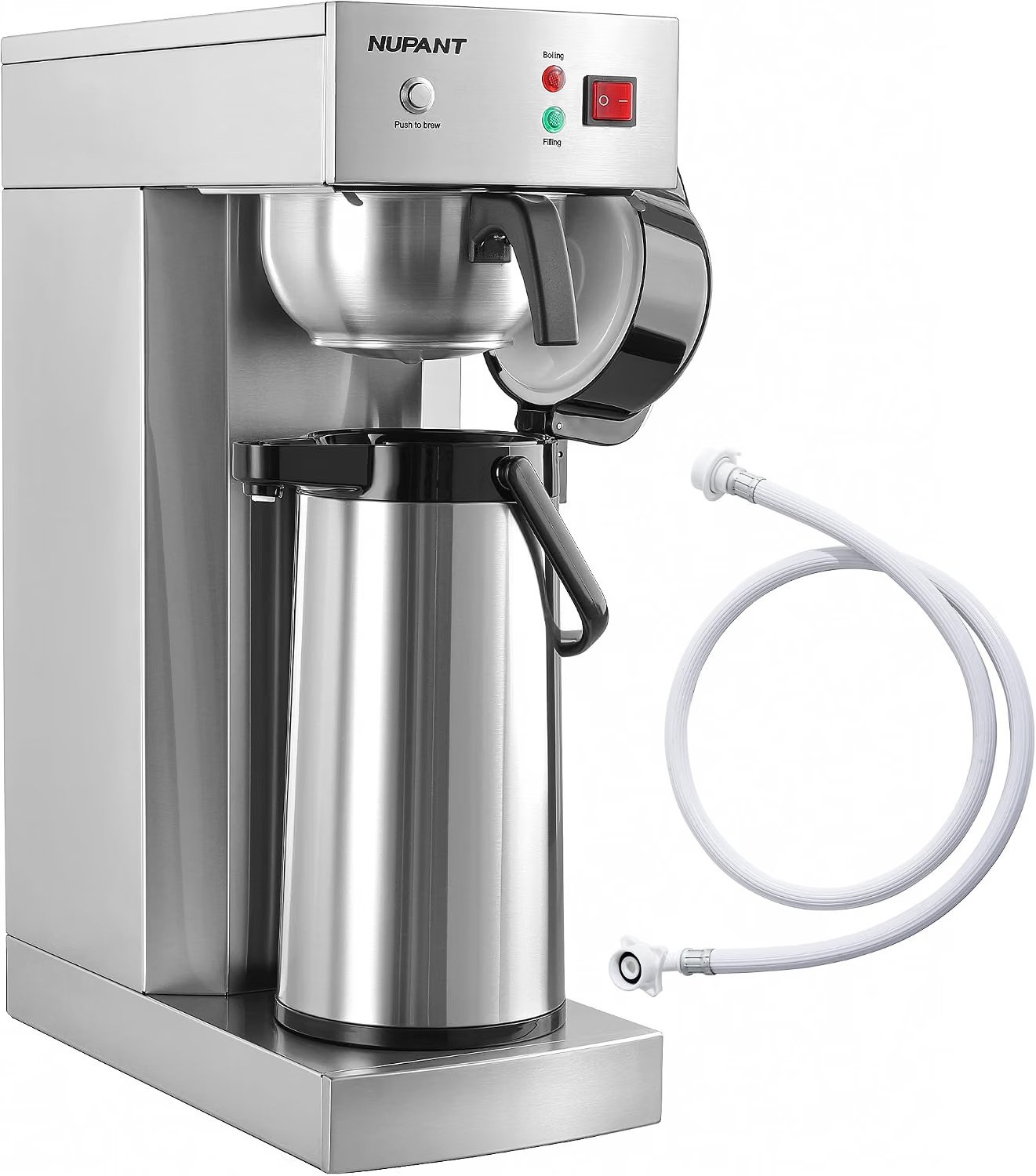
A practical middle ground for offices, restaurants, and meeting spaces that want automatic water filling without leaving brewed coffee on a hot plate.
Buy it ifYou want direct-water convenience plus a portable 2.2 L thermal airpot for serving away from the brewer.
Skip it ifYou prefer glass decanters, multiple warmers, or a simpler machine with fewer installation variables.
This NUPANT-style airpot system changes the holding method rather than simply making the brewer larger. The supplied product listing describes an auto-filling commercial airpot brewer, while available RPA-386 documentation lists a 2.2 L (74 oz) capacity, stainless-steel body, 120V operation, 1450W power, and automatic water filling.
The appeal is service flexibility. Brew into the thermal airpot, move the pot to a conference room or serving station, and avoid continuously heating the same coffee on a warmer plate. That makes this format especially relevant to workplaces; compare it with the options in our best office coffee maker guide if your main goal is employee or meeting-room service.
Capacity2.2 L / 74 oz
Water feedAutomatic fill
Power120V · 1450W listed
What we like
Thermal holding avoids a hot plate
Automatic filling reduces manual refill work
Airpot can move to the serving area
What to consider
Taller airpot format needs vertical clearance
Direct-water installation must be planned
Exact included airpot and fittings should be confirmed
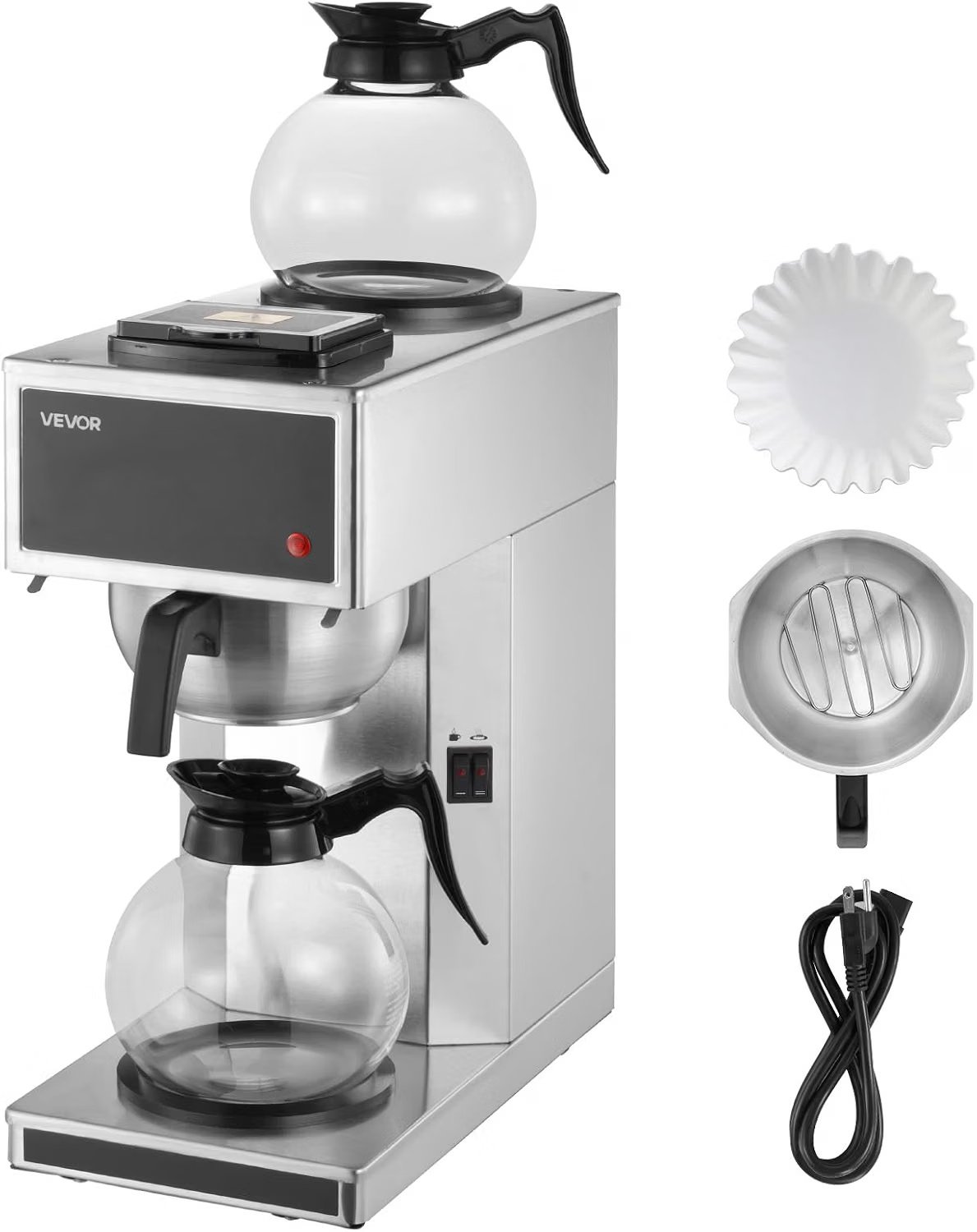
A straightforward two-carafe commercial setup for buyers who want faster batch service without committing to a plumbed BUNN-style installation.
Buy it ifYou want a stainless commercial drip machine with two glass carafes and two warming plates.
Skip it ifYou need automatic water filling, thermal holding, or the strongest long-term service network.
VEVOR lists its RB-286 commercial drip brewer with a 2.8 L water tank, 1.8 L glass carafe capacity, 1610W power, two warming plates, and two glass carafes. The format is familiar: brew a pot, move it to the second warmer when needed, and start another batch.
That simplicity can be useful in a small restaurant, reception area, or church kitchen where staff already understand pour-over commercial brewers. It is less elegant for long holding periods, because glass carafes on warmers reward frequent turnover. For a broader look at food-service workflows, see our restaurant coffee maker guide.
Water tank2.8 L listed
Carafe1.8 L glass
Power1610W listed
What we like
Two-carafe workflow is easy to understand
No permanent plumbing required
Stainless housing and removable funnel simplify routine cleaning
What to consider
Manual refilling adds staff steps
Hot-plate holding favors frequent turnover
Long-term parts support is less established than BUNN
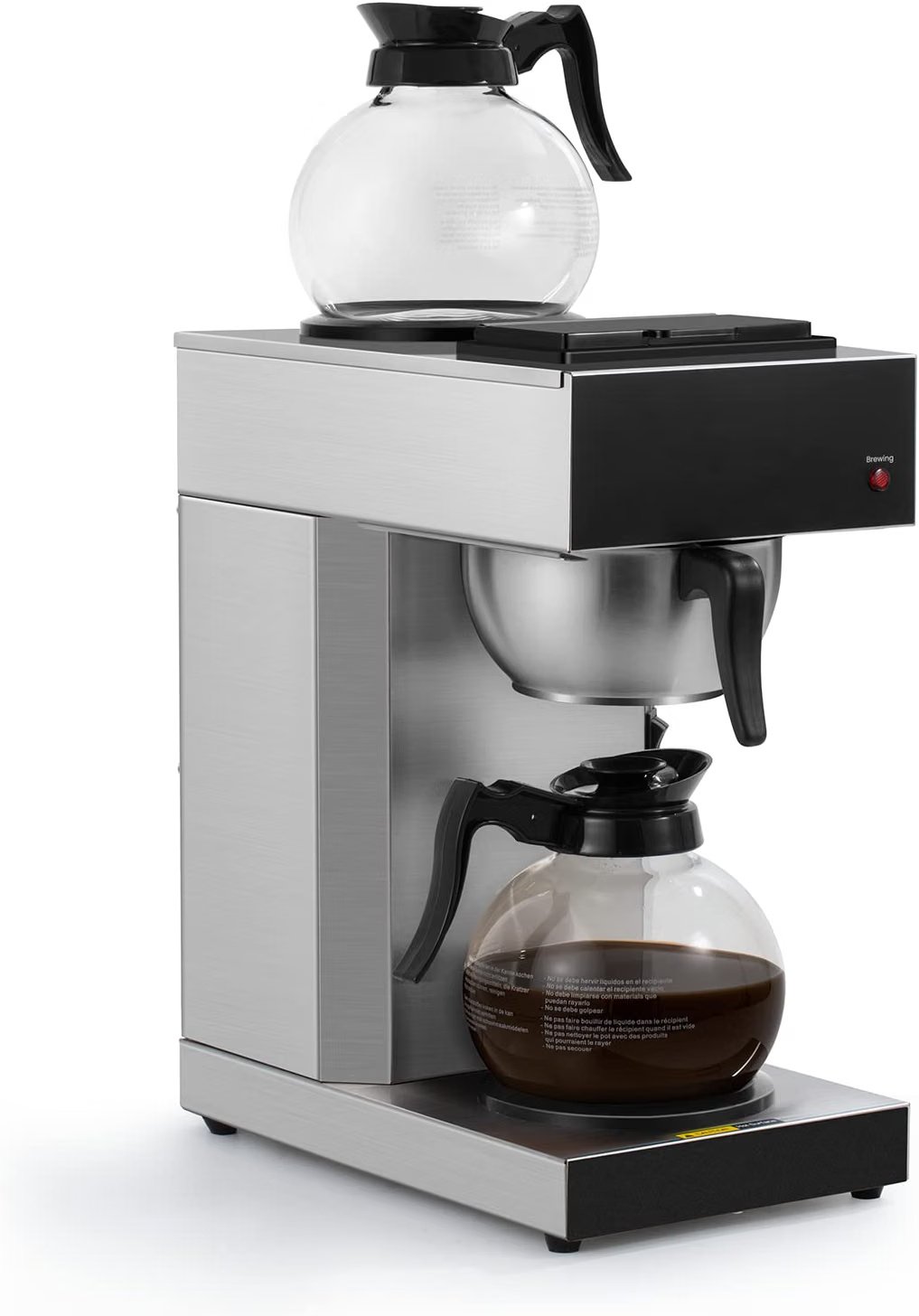
A no-plumbing commercial brewer for counters that need a familiar 12-cup batch routine and an extra hot plate without a direct water connection.
Buy it ifYou need commercial construction but want to fill the brewer manually rather than install a water line.
Skip it ifYour staff will brew continuously enough that pitcher refilling becomes a bottleneck.
SYBO’s operating instructions identify the SF-CB-2GA as a commercial coffee maker with roughly 12-cup capacity, 120V input, a main hot plate, an extra hot plate, a brew chamber, and a manual water entrance. The operating sequence is conventional: load a paper filter and grounds, slide in the basket, place a decanter, and pour in cold water.
That makes it easy to understand and easy to relocate, but the human step is also the limitation. A manually filled brewer is practical for moderate demand; at genuinely continuous volume, an automatic plumbed brewer reduces labor and helps standardize the cycle. The available SYBO documentation contains inconsistent wattage entries for this model family, so we would verify the exact linked revision before publishing a power figure.
Specification source reviewed: SYBO SF-CB-2GA operating instructions. Conflicting wattage entries are intentionally not presented as a settled specification.
The volume-first option for catering, churches, buffets, and large meetings where one big self-serve batch matters more than café-style batch rotation.
Buy it ifYou regularly serve dozens of people at once and want one large insulated percolator-style vessel.
Skip it ifYou care more about small fresh batches, fast recipe changes, or keeping different coffees in rotation.
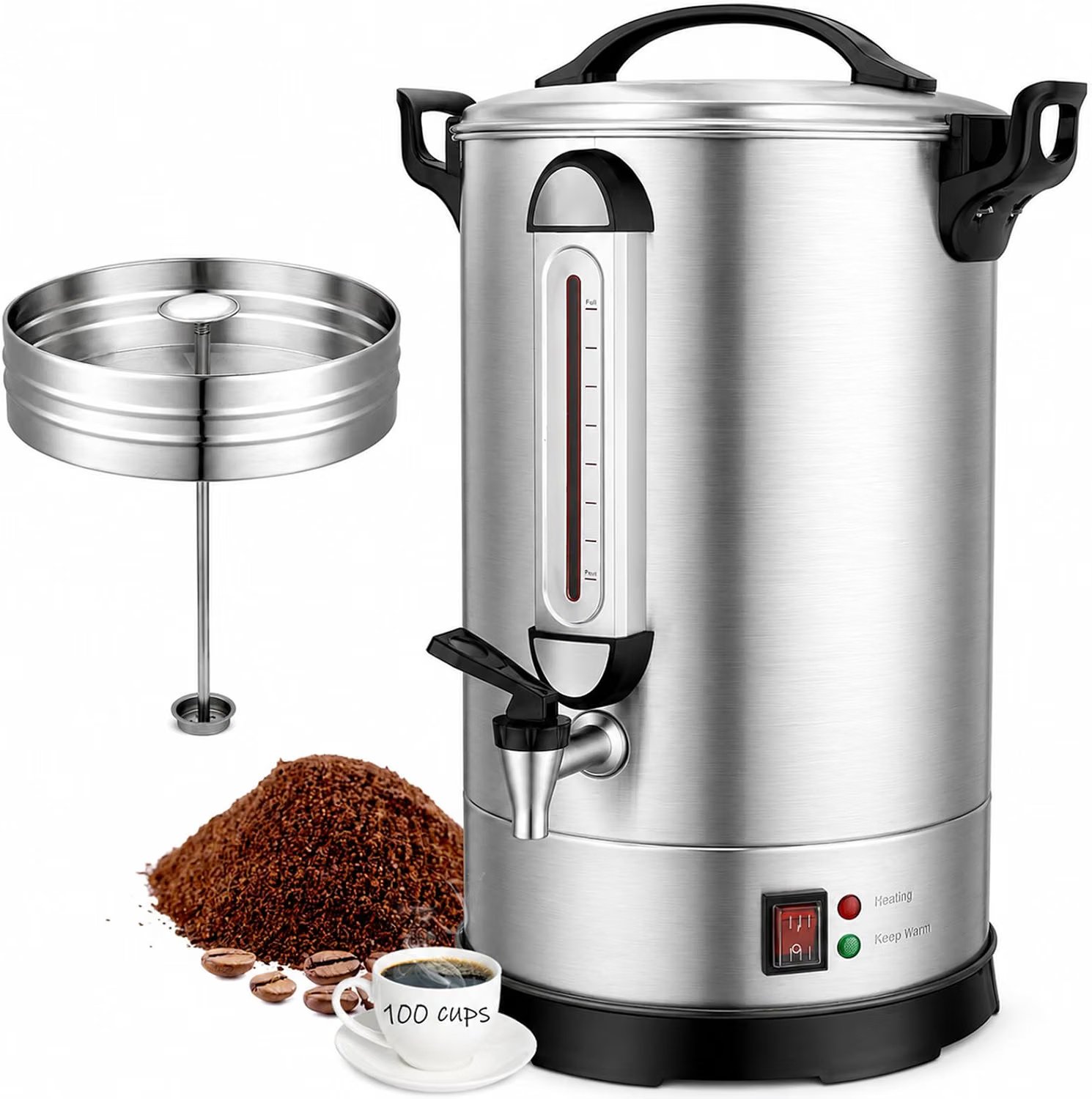
The supplied product listing describes a 100-cup industrial electric coffee percolator with a 1300W heater, 304 stainless-steel double-wall construction, and a hot-beverage dispenser format. Matching retail documentation for this product class describes roughly 16 L / 4 gallon capacity and use cases such as catering, churches, hotels, and conferences.
This is a different tool from a 12-cup commercial drip brewer. It trades small-batch freshness and easy recipe changes for sheer serving capacity. That can be exactly right for an event breakfast or church hall, but it is usually the wrong answer for a café serving coffee throughout the day. Because large urn listings are frequently revised or rebranded, match the capacity, wattage, plug, faucet, and inner-wall material on the Amazon destination page before ordering.
Capacity100 cups · ~16 L class
Heating1300W in supplied listing
Body304 stainless, double-wall listed
What we like
Very high single-batch capacity
Self-serve faucet suits events and buffets
Double-wall urn format improves heat retention
What to consider
Large batches are less flexible
Not intended for specialty café-style service
Exact linked seller/model should be verified before purchase
Specification basis: the supplied Amazon product title plus matching 100-cup commercial-urn retail documentation. Confirm the exact linked model before publishing fixed dimensions or performance claims.
Four decisions that matter more than the word “industrial”
Plumbed or manually filled?
A plumbed brewer removes a repetitive staff step and makes sense for continuous service. A pour-over model is easier to install and relocate, but every batch needs someone to refill it.
Hot plate or thermal holding?
Warmers are familiar and inexpensive, but coffee quality falls the longer a glass decanter sits on heat. Thermal airpots are more portable and better suited to meeting rooms, counters, and remote serving points.
12-cup batches or a large urn?
Small commercial batches make it easier to keep coffee fresh and rotate blends. A 50- or 100-cup urn is better when many people arrive at the same time and self-service matters more than frequent fresh brewing.
What will installation require?
Check voltage, plug type, water pressure, drain expectations, cabinet clearance, filter access, and the path staff use to remove a full carafe or airpot. Our office coffee machine guide is useful if the machine will live in a workplace rather than a restaurant.
Quick answers
Common questions before buying an industrial coffee maker
What is an industrial coffee maker?
In shopping terms, “industrial coffee maker” usually refers to commercial-duty equipment built for larger or more frequent service than a typical home brewer. The category can include plumbed batch brewers, commercial pour-over machines, airpot brewers, and large coffee urns, so the water-feed and holding method matter as much as cup capacity.
Is a plumbed commercial coffee maker better?
It is better when staff brew repeatedly throughout the day because automatic water filling removes a manual step. It is not automatically better for temporary stations, catering, low-volume offices, or locations where adding a water line is impractical.
How many cups should a commercial coffee maker brew?
Choose around your peak service pattern, not the biggest advertised number. A 12-cup brewer can work well when batches turn over quickly, while a 50- or 100-cup urn is more appropriate when a large group needs coffee at roughly the same time.
Are thermal airpots better than glass carafes on warmers?
They solve different problems. Thermal airpots make coffee easier to move and avoid continuous hot-plate heating. Glass carafes on warmers make it easy to see volume and rotate pots quickly at a fixed service counter.
What should I check before connecting a commercial coffee brewer?
Confirm voltage, amperage, plug type, water-line size, permitted water pressure, filtration needs, counter clearance, and local installation requirements. Follow the exact model manual rather than assuming every commercial brewer uses the same connection.
Recommended next
Continue your commercial coffee research
Compare adjacent commercial brewing setups before choosing the machine that will anchor your service area.